How Michael Clinesmith Writes a Piece of Piano Music
The most reliable way to understand the Michael Clinesmith composing process isn’t to ask about it — it’s to sit down with the finished record and read backward. Piano Reveries is twenty-two solo piano tracks, and the shape of every one of them is a decision someone made and then refused to undo. Twenty-two pieces is a lot of evidence. Line them up and the working method starts showing through the music itself, the way brushstrokes show through a painting once you stand close enough.
Starting from a single melodic idea
Look at the titles on this album and you’ll notice how many of them name one thing rather than describe a scene. Two Beat. Bb Melody. Melody in C. Bouncing Left Hand. Dance in D.
Those aren’t poetic titles. They’re honest ones. They tell you the piece began as a single musical idea — a rhythm, a key, a gesture in one hand — and that the idea was strong enough to name the finished work after it. A composer who starts from a mood board and fills in the notes afterward doesn’t end up with a track called “Bouncing Left Hand.” A composer who starts from an actual bouncing left hand does.
That’s the first move, and it’s the one most beginning writers skip. Not “I want to write something sad.” Something smaller and much more useful: here is a figure my hands found, and it keeps being interesting on the fifth pass. Everything else in the piece gets built to serve that.
You can hear the same instinct at work when the idea is emotional rather than mechanical. After the Storm opens the album at 6:44 and The Sun Will Rise Again closes its final stretch at 8:42 — the two longest pieces on the record. Both titles point at a single image held steady for a long time, not a plot with several turns in it. One idea, given room.
Keeping what feels true, cutting the rest
The second thing the tracklist reveals is a real willingness to let a piece be exactly as long as its idea can support, and not one bar longer.
Twenty-two tracks range from 0:49 to 8:42 on this album. That spread is not an accident of assembly. It’s what happens when the length of each piece is decided by the material instead of by a format. Happy Anniversary is forty-nine seconds because forty-nine seconds is apparently what it had to say. Joyous is 1:50. “Two Beat” is 1:37. Meanwhile Minor Major 2 runs 7:56, because that idea genuinely needed the room to work itself out.
Most of the padding in amateur composition comes from a single fear — that a short piece will read as an unfinished one. The cure is to trust the idea. If the figure at the heart of the piece has been fully explored in ninety seconds, adding a second theme to reach a respectable duration doesn’t make the work bigger. It makes it two smaller works stapled together.
There’s an easy test buried in this album. Play Race at 3:24, then play “The Sun Will Rise Again” at 8:42, and ask which one feels long. Neither does. That’s the whole trick.
Letting a piece stay short and honest
Solo piano is a merciless format for hiding in. There’s no string section to swell underneath a thin passage, no drum kit to manufacture urgency, no production gloss to sit over a middle eight that isn’t working. Ten fingers, eighty-eight keys, and whatever the writing actually is.
That constraint is doing a lot of quiet work across this record, and it shows up most clearly in the pieces that stay in one emotional register instead of escaping into a big finish. Working Through It is tagged as a thematic piece and runs 5:04 without resolving its difficulty early. Minor Major sits in an unsettled place for 7:29 and lets you feel it.
The honest version of a piece is usually the one that declines the rescue. It’s tempting to write the triumphant lift at ninety seconds because the lift is satisfying to play and satisfying to hear. But it’s often a lie about the subject, and listeners can tell — not consciously, just as a faint sense that the music solved something it hadn’t earned.
Capturing the take
There’s a difference between a piece being finished on paper and a piece being finished in the air, and solo piano makes that gap unusually wide.
Something like Jade’s Lullaby at 2:58 or Play in the Grass at 4:00 lives or dies on touch. The notes are the same notes at any dynamic; what makes a lullaby feel like a lullaby is weight, pedaling, and the specific unhurriedness of the hands. None of that is fully notatable. It has to be performed into existence, which means the last stage of writing is really a listening stage — playing the piece repeatedly and deciding which reading of it is the true one.
That’s also why breadth matters here. The Joy in Life is tagged flamenco. Lovely Night is jazz. For Grandma sits under funk/soul. “Bb Melody” is chillwave. These aren’t stylistic costumes dropped on top of identical piano pieces — each one demands a different physical approach at the keyboard, and getting the take right means playing in that idiom rather than near it.
How the Michael Clinesmith composing process shows up on Piano Reveries
Zoom out from the individual tracks and one more decision becomes visible: the album’s running order is composed too.
The clearest example is the three-movement Sonatina in G, which lands at tracks five, six and seven — 5:21, then 3:15, then 2:46, tightening as it goes. It’s the most formally classical structure on the album, and it’s placed early, right after the gentleness of “Jade’s Lullaby,” where a listener still has the patience for a full multi-movement argument. Then the record loosens up again into Step and Dance and the shorter character pieces.
The final three tracks make the same point even more plainly. “Working Through It,” then “The Sun Will Rise Again,” then “Happy Anniversary.” Struggle, hope, celebration — in that order, at 5:04, 8:42 and 0:49. Read as a sequence, it’s a small three-act structure that no single piece on the album could deliver alone.
That’s the last stage of the process, and the one people forget is a stage at all. Twenty-two finished pieces aren’t an album yet. The order is the final composition.
Hear it for yourself
The honest test of any composing method is whether the music holds up without the explanation attached to it. You can play previews of all 22 tracks and buy Piano Reveries right here — individually or as the complete album — and hear whether these choices land.
If you’d rather have the notes under your own hands, Michael’s scores are published through Sheet Music Plus and Sheet Music Direct — reading a piece from the inside teaches you more about how it was built than any article can.
The same working method carries into the studio’s game music. Rebellion, the indie RPG on Steam, needed cues that could hold a mood across long stretches of play instead of tidying themselves up every thirty seconds, and you can hear how that turned out in the Rebellion Soundtrack DLC.
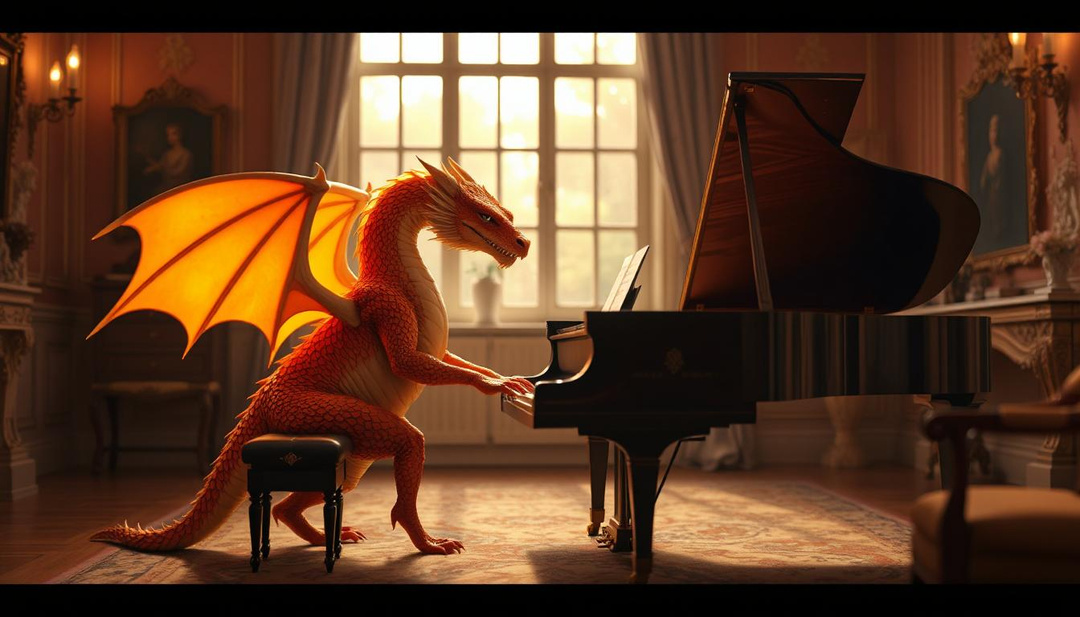
To follow new music as it goes out, subscribe on YouTube. To support the work directly and see more of how it gets made — Airy the Dragon included — Patreon is the place. And if your own project needs a piece written to fit it, you can hire Michael for a custom score on SoundBetter.
Every finished piece is just a long series of small refusals to add something unnecessary. Twenty-two times over, that becomes a record.
If this resonated, you can listen to and buy Piano Reveries, learn more about the music, or get in touch about a custom score.
 Track Spotlight
 Track Spotlight: "Minor Major" and "Minor Major 2" — Fifteen Minutes on One Idea
A close listen to the paired "Minor Major" pieces on Piano Reveries — two of the longest, most exploratory solo piano tracks by Michael Clinesmith.
 Track Spotlight
 Track Spotlight: "Play in the Grass" — Piano Reveries at Its Most Playful
A close listen to "Play in the Grass" from Piano Reveries — the light, bright, playful solo piano piece by composer Michael Clinesmith.
 Track Spotlight
 Track Spotlight: "The Sun Will Rise Again" — the Album's Long Sunrise
A close listen to "The Sun Will Rise Again" from Piano Reveries — the hopeful, 8:42 thematic piece that is the longest track on Michael Clinesmith's 22-track album.