From Game Dev to a Solo Piano Album

Most indie studios hire someone to write the music. Most composers never ship a game. The road from game dev to album is not one many people walk in either direction, and Endtime Entrepreneurs ended up walking it because one person kept refusing to hand either job away. Michael Clinesmith built the worlds, wrote the code, drew the dragon, and then sat down at the piano and scored all of it himself — until the music grew too big to stay inside the game.
Starting in indie game development
The studio began the way most small studios begin: with a person making something nobody had asked for yet.
Michael Clinesmith has spent years building worlds you can actually play in — an indie RPG, a cheerful little guinea-pig game, characters with faces and names. Online he goes by AiryTheDragon, after the orange cartoon dragon that became the studio’s mascot and, over time, his composing persona. If you have seen the dragon on the album cover, on Patreon, or on the YouTube channel, you have already met the throughline connecting a game studio to a piano record.
What is unusual is that the music was never a later addition. It was there from the beginning, in the same hands. Some of the earliest pieces that would eventually land on Piano Reveries were written between 2005 and 2007 — Bb Melody, Minor Major 2, and Lovely Night all predate the games they would later share a studio with. The composer showed up first. The developer arrived to give him somewhere to put it all.
Scoring Rebellion and Airy’s world
Rebellion is the studio’s flagship game, an indie RPG that went live in beta on Steam in 2023, with a Soundtrack DLC following after. It has a hooded wizard, an adventure, and the particular kind of energy that makes a composer want to write a theme rather than a background loop.
That distinction matters more than it sounds. Game music written on deadline by an outside contractor tends toward function: this cue is for the town, this one is for the fight, this one is thirty seconds and needs to loop invisibly. Game music written by the person who also invented the town works differently. There is no brief to interpret, because the writer already knows what the place feels like. He has been there since it was a sketch.
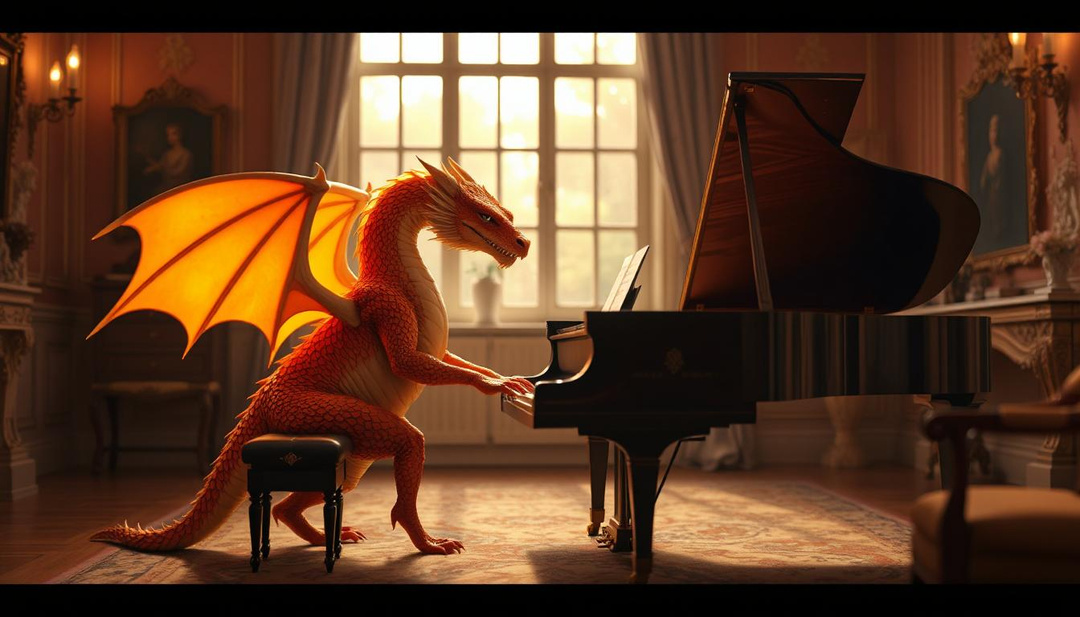
So the pieces came out as pieces. Thematic writing like Working Through It and The Sun Will Rise Again carries a shape that keeps going after the scene would have ended — the second of those runs 8:42, which is not a length anyone chooses when the goal is a tidy background loop. That is a composer writing music for its own sake, inside a game, and then noticing what he has on his hands.
The pieces that became Piano Reveries
The turn from game dev to album happened when the catalog outgrew the container.
Piano Reveries is twenty-two original tracks, and it is emphatically not a soundtrack rip. It spans eight genres — classical, jazz, funk/soul, flamenco, chillwave, pop, thematic film-score writing, and straight solo piano — with the instrument itself as the only constant. The Joy in Life is flamenco. For Grandma sits under funk/soul. Jade’s Lullaby is two minutes and fifty-eight seconds of pure quiet. The three-movement Sonatina in G is a genuine classical form, sitting a few tracks away from a chillwave cut.
That range is what a decade-plus of writing for your own projects actually produces. Nobody commissions a flamenco piano piece, a 7:29 minor-key meditation like Minor Major, and a forty-nine-second anniversary miniature from the same person in the same year. You only end up with that spread if you have been writing continuously, for yourself, without waiting for permission — which is precisely what happens when the composer and the studio owner are the same guy.
Twenty-two tracks, and the album opens with After the Storm at 6:44. Not a playlist-friendly opener sized for a first impression. A statement.
Stepping out from behind the game
Releasing an album under your own name is a different act than shipping a game. A game hides you a little. The player is looking at the wizard, not at you.
Piano Reveries removed the hiding place, and then 2025 removed it further: the Vassar City Band performed the album live as a full ensemble, taking piano-led compositions written alone into orchestra territory in front of an actual room of people. Music that started as one person and eighty-eight keys came back as a band. That is the moment a private catalog becomes a public body of work.
The full 22-track album now lives on the site, where you can preview every track and buy the record — either the complete album or individual pieces. The Soundtrack DLC is still there on Steam for players who want the music tied to the world it came from. Both doors lead to the same place. They just start from different rooms.
What the studio is building next
Endtime Entrepreneurs sits in an odd, useful spot: the indie game studio that writes its own albums, and the music project that also ships RPGs. The two halves keep feeding each other, and the plan is to keep them both running.
That means more worlds — a new one every couple of years, each arriving with its own original score. It means the sheet music catalog stays open, published on Sheet Music Plus and Sheet Music Direct, so other players can put their own hands on these pieces instead of only listening to them. And it means the custom work continues: if you are building something that needs a real score rather than a stock cue, Michael takes commissions through SoundBetter.
The honest summary of the journey from game dev to album is that there was never a switch. There was a composer who built games so the music would have somewhere to live, and then wrote enough of it that the music needed a home of its own.
If this resonated, you can listen to and buy Piano Reveries, read the full studio story, support the work on Patreon, or get in touch about a custom score.
 Track Spotlight
 Track Spotlight: "Minor Major" and "Minor Major 2" — Fifteen Minutes on One Idea
A close listen to the paired "Minor Major" pieces on Piano Reveries — two of the longest, most exploratory solo piano tracks by Michael Clinesmith.
 Track Spotlight
 Track Spotlight: "Play in the Grass" — Piano Reveries at Its Most Playful
A close listen to "Play in the Grass" from Piano Reveries — the light, bright, playful solo piano piece by composer Michael Clinesmith.
 Track Spotlight
 Track Spotlight: "The Sun Will Rise Again" — the Album's Long Sunrise
A close listen to "The Sun Will Rise Again" from Piano Reveries — the hopeful, 8:42 thematic piece that is the longest track on Michael Clinesmith's 22-track album.